
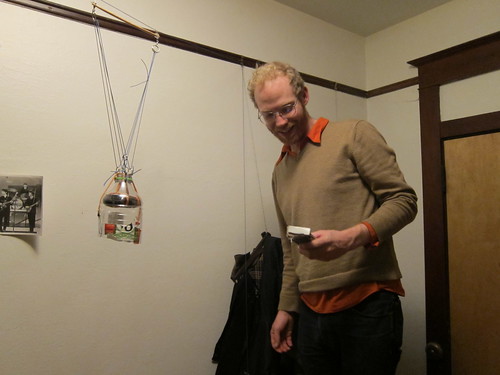
A Picavet rig is a very common type of KAP/BAP rig, I've added it to the juice bottle in a fairly simple way, using 1/2" key rings.
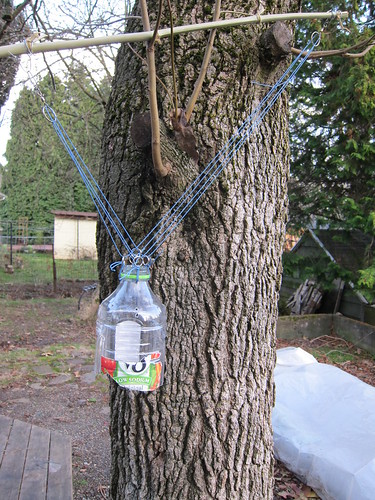
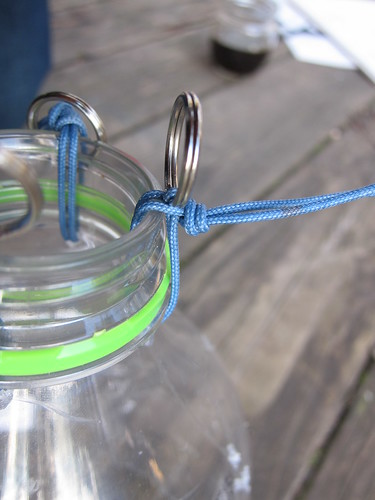
It makes a good Zip line attachment, and looks like it might provide better stability, especially in light wind, than the single line + fin system we've been using.
5 Comments
I love how simple this is. Looking forward to trying it out, thanks!
Reply to this comment...
Log in to comment
This is a very interesting take on the Picavet. I do have a couple of comments. First, as I understand it one of the important design aspects of a Picavet is that the strings need to move freely rather than being tied off at the rig attachment points. Many people, including myself, use tiny little blocks to cut down on friction. However, the use of single links of bike chains and o-rings (like the one in the design here) are also common solutions. I’d suggest trying out a model wherein the string is not tied either to the cross at the top or to the rings on the attachment point of the rig, but rather the single line of string is free at both ends. I see the link to David Hunt’s nice page on Picavets. Davids page shows the line moving freely through the rig attachment points. The page illustrates the little Pekabe Blocks I mentioned, but also shows some examples where simple rings are employed.
In terms of Picavet design, James Gentles has done some really interesting tests and comparisons. He found that an X wherein one side is considerably longer (wide narrow) is more stable than an X of equal lengths (either large or small). I have tried both wide-narrow and small styles myself and following James’s conclusions, I find that a Picavet wherein one axis of the X is longer (wide-narrow) is much more stable than small. I’ve not tried the “large” configuration. I find that the gains from the wide-narrow picavet are really significant when using simple and light rigs like the hallmark grassrootsmapping soda bottle design (that is oh so elegant). I can’t seem to find a copy of the original paper by Pierre Picavet, but I’ll keep looking. In the mean time, here is a webpage that details the experiments done by James. http://www.gentles.info/KAP/PICAVET/experiment.htm
Lastly, Scott Armitage has found that a single long line is very effective at stabilizing and he’s exploited this with a very simple rig that looks much like some flavors of the soda bottle rig. There is more discussion of this system on the KAP discussion board, but it seems down this morning. In the mean time, here is an image of Scotts rig design. It is coupled with a single long line of string that attaches to the kite twine. https://www.flickr.com/photos/dunehaven/4601949466/in/set-72157603230993271
Reply to this comment...
Log in to comment
Are there any instructions of this design or a larger quantity of detailed pictures?
Is this a question? Click here to post it to the Questions page.
Reply to this comment...
Log in to comment
In addition to those in the Flickr feed.
Reply to this comment...
Log in to comment
no, there aren't. sorry. I usually don't fly this rig and just go for the regular long-line version.
Reply to this comment...
Log in to comment
Login to comment.