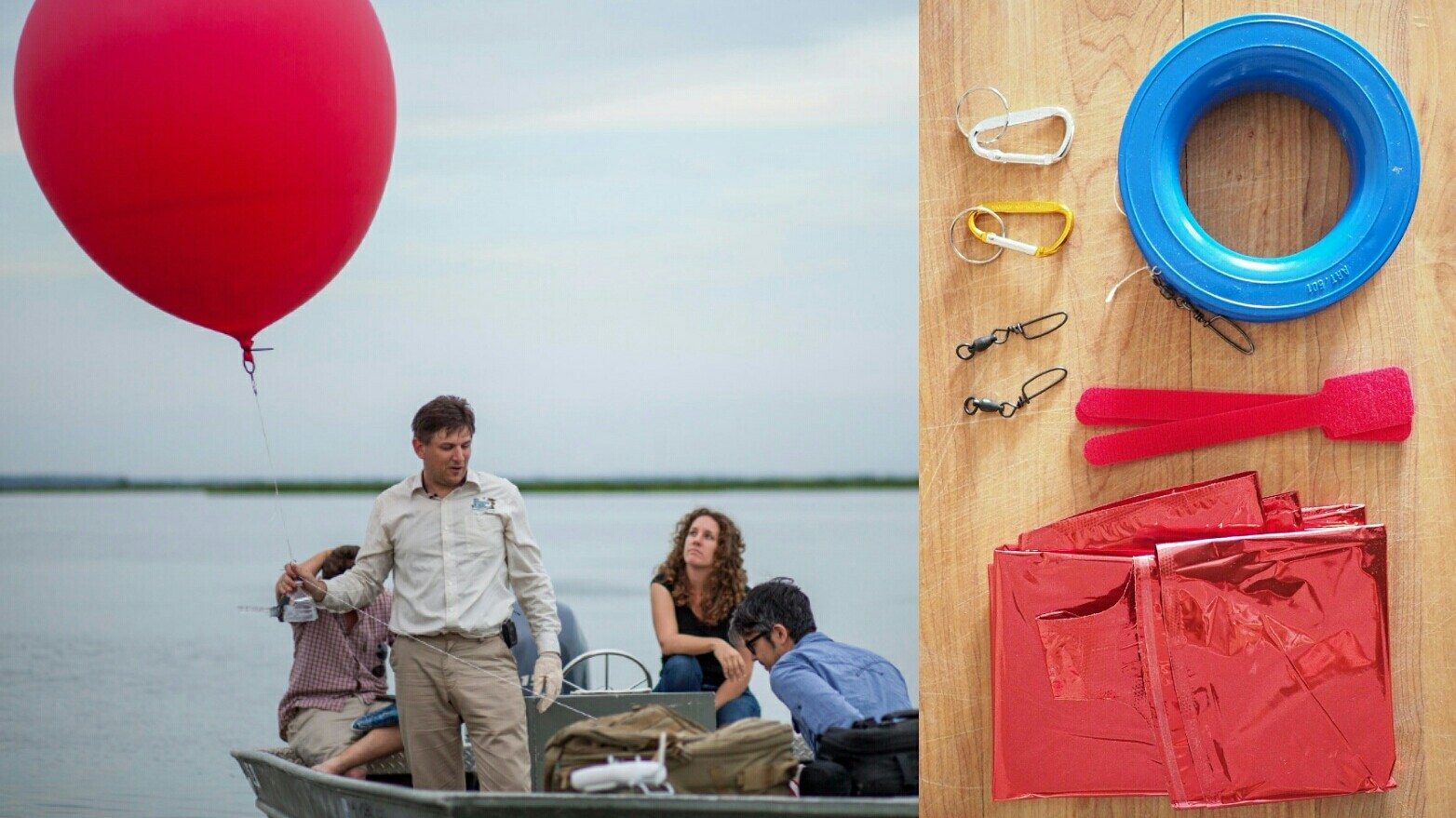
Balloon Mapping

Satellite images can be a great place to start when making a map. But Google’s images are often several years old, and may not be high resolution enough. And isn’t it creepy that they’re taking pictures of you?
With a helium filled balloon you can take your own aerial pictures, stitch them together, and view them a web map like Cartagen or Google Maps. We’re working on a way to trace them and create a PDF to print out.
When you fly your balloon, check for any local regulations - federal regulation say less than 500 feet high is OK, and if your balloon is smaller than 6-feet in diameter and less than 115 cubic feet in volume, you're even excepted from that: Federal moored balloon regulations. Try to stay away from tall buildings because you could scrape against them, but also because the wind currents near them cause a lot of turbulence and your photos come out blurry.
Materials
(See Balloon Mapping Materials for a full list of required materials)
Balloons
Weather balloons can be kind of pricey, starting at ~$12 US dollars in packs of 2 (for 24 dollars total plus shipping) for a three foot wide and 20 dollars plus shipping for an eight-foot balloon. You can compare prices here:
Helium
Helium can be bought from Airgas if they’re nearby, or you can ask your local party store where they get theirs. A small tank of 80 cubic feet or so should be enough for a couple flights, at about ~$30. We’re also experimenting with hot air balloons and hydrogen balloons but don’t advise that you try this yet.
(Some great documentation on building this rig and using even hot air balloons can be found here: http://www.paulillsley.com/airphoto/systems/balloons-kites.html)
String
You’ll need about 500 feet of string minimum, and 1000-1500 feet is better. Either nylon (#18) from the hardware store will do; I've used a $3 roll of woven nylon string. I worry about the string getting caught on a building so I think the woven stuff is good - it can fray without breaking.
Video of winding 4,500' of string onto a reel with a bicycle.
Camera mounting
Your camera will bob and wave around in any amount of wind. I try to fly balloons only in minimal wind (less than 5mph) but if you do have bobbing and spinning you can stabilize things by using a Picavet suspension, which is made from a small wooden X (about a 30 cm across) with rings at each corner, and a kind of complicated string setup. I taped the camera to the center of the X and things improved a lot. See instructions for a Picavet here: Picavet suspension
A simpler rig can be made from a soda bottle: Soda Bottle Rig

Camera
You’ll need a camera which can take pictures automatically every 10 seconds. Most Canon cameras can be used with the CHDK, a firmware hack which lets you run scripts off your SD card. Put the following script in the scripts folder on the card once you’ve installed the CHDK. (We need a Chdk Troubleshooting? page… coming soon)
Download script (right-click to save, or option-click on a Mac)
See also:
It’s also worth it to set your shutter speed really high - like 1/500 or 1/1000. My Canon didn’t have shutter speed settings so I turned up the ISO as high as it’d go. My images are grainy but fairly sharp. For the additional information concerning the settings of the camera you have, check the page for the specific model on the CHDK wiki.
If you have trouble with your camera turning off mid-flight, see the ChdkIssues page for suggestions... basically use new-ish batteries and fully charge them before flying.
Camera alternatives
For more camera options, see CameraOptions - it's possible to use any Android phone which is easier though more expensive. Flip video cameras also work.
Combining the images into a map
[Cartagen Knitter](http://cartagen.org/maps) can be used to 'knit' the images you've captured into a completed, georeferenced map.
Once you’ve captured a bunch of photographs you’ll need to stitch them together. Try Cartagen Knitter (more information at the CartagenKnitter page)
Keep in mind that you’ll want a lot of images that overlap quite a bit, and that are generally pointing downward. The more sideways your images, the harder it’ll be to warp them and stitch them together.
Additional References
What links here
No backlinks found.
Activity
-
On Jun 18, The creator of [GrassrootsMapping.org](http://grassrootsmapping.org) and co-founder and Research Director for the Public Laboratory for Open Technology and Science, Jeff designs mapping and civic science tools and professionally flies balloons and kites. Notable software he has created include [the vector-mapping framework Cartagen](http://cartagen.org) and [orthorectification tool MapKnitter](http://mapknitter.org), as well as open spectral database and toolkit [Spectral Workbench](http://spectralworkbench.org). He is a fellow at MIT's [Center for Civic Media](http://civic.mit.edu), on the advisory board of [Personal Democracy Media's WeGov](http://techpresident.com/topics/wegov) and an advocate of open source software, hardware, and data. He co-founded Vestal Design, a graphic/interaction design firm in 2004, and directed the Cut&Paste Labs project, a year-long series of workshops on opensource tools and web design in 2006-7 with Lima designer Diego Rotalde. Jeff holds an MS from MIT and a BA in Architecture from Yale University, and spent much of that time working with artist/technologist Natalie Jeremijenko, building robotic dogs and stuff. To find out more, visit Unterbahn.com. * https://github.com/jywarren * http://unterbahn.com * http://unterbahn.com/thesis/ updated Page: About Public Lab
-
Adam-Griffith commented on Adam-Griffith's Note "Folly Beach, SC - a detailed look at a $3 million beach "restoration"" on Jun Tuesday
-
Adam-Griffith commented on scaramel's Note "Video: Kitemappers" on Jun Tuesday
-
On Jun 13, Caterina Scaramelli created a new Note: Video: Kitemappers
-
On Jun 12, Stewart Long updated Map: Rotsoord. Utrecht, Netherlands.
-
On Jun 12, Stewart Long updated Map: Rotsoord. Utrecht, Netherlands.
-
On Jun 12, Stewart Long updated Map: Rotsoord. Utrecht, Netherlands.
-
On Jun 12, Hagit Keysar updated Page: MapKnitter Help
-
sonofaquark commented on sonofaquark's Note "Pascal's Wager" on Jun Wednesday
-
On Jun 10, www.quiviracoalition.org created a new Note: Test 1
-
On Jun 9, Shannon created a new Note: Public Lab community newsletter 6.9.13
-
tomh4236 commented on nedhorning's Note "Canon A2200 NIR conversion" on Jun Wednesday
-
On Jun 5, Adam D. Griffith is the Director of the Rivercane Restoration Project through the Program for the Study of Developed Shorelines (PSDS) at Western Carolina University. He received a BS degree in Biology from Roanoke College in 1999 (Omicron Delta Kappa) and was subsequently accepted to Teach for America. He taught 6th grade science in the Houston Independent School District in Texas for three years before becoming a kayak instructor taking him on numerous trips to the beaches of the United States, Panama, and Europe. He received his MS degree in Biology from Western Carolina University in 2008 studying the native bamboo Arundinaria gigantea. Since 2008, he has been a research scientist at PSDS where he launched coastalcare.org with the Santa Aguilla Foundation. He currently directs the communities and sea-level rise research. In 2011, he co-founded the Public Laboratory with 6 others by securing a $500,000 grant from the James S. and John L. Knight Foundation. As a result, his writings can be found on the PBS IdeaLab blog, publiclaboratory.org, and others. He has presented his research with the Public Laboratory across the United States, Mexico, and Europe. Selected Publications Tanner, B.R., Kinner, D.A., Griffith, A.D., Young, R.S. & Sorrell, L.M (2011). Presence of Arundinaria gigantea (river cane) on numerous non-wetland sites suggests improper ecological classification of the species. Wetlands Ecology and Management. 19(6): 521-532. Coburn, A.S., Griffith, A.D. & Young, R.S. (2010). Inventory of coastal engineering projects in coastal national parks. Natural Resource Technical Report NPS/NRPC/GRD/NRTR???2010/373. National Park Service, Fort Collins, Colorado. Griffith, A.D., Kinner, D.A., Tanner, B.R., Moore, A., Mathews, K.G. & Young, R.S. (2009). Nutrient and physical soil characteristics of rivercane (Arundinaria gigantea) stands, western North Carolina. Castanea. 74(3): 224-235. updated Page: Classification
-
dan.beavers commented on patcoyle's Note "Prototype juice bottle rig on R-10 UAir quad" on Jun Wednesday
-
On Jun 4, Stewart Long updated Map: Montgomery Bell State Park. Burns, Tennessee
-
On Jun 4, Stewart Long created a new Map: Montgomery Bell State Park
-
On Jun 4, Stewart Long updated Map: Rotsoord. Utrecht, Netherlands.
-
On Jun 4, Stewart Long created a new Map: Rotsoord. Utrecht, Netherlands.
-
On Jun 4, Stewart Long updated Map: Washington Crossing, Pennsylvania.
-
On Jun 4, Stewart Long created a new Map: Washington Crossing, Pennsylvania.

